Friday, July 31, 2015

Coupling between Edelkrone's SliderPlus+Action Module and the Syrp Genie for motion control

Although I'm writing this as a memo for future reference, in case I forget the precise mechanics I describe, anyone with similar interests is also welcome to read.

I recently bought a number of items from Edelkrone, that I consider one of the best if not the best supplier of cinematography peripheral products for pro's and sophisticated enthusiasts like myself. For this article in particular, I am referring to Edelkrone's SliderPlus Small slider, their Action Module and their FlexTilt head. In the picture above, the slider is easily seen; the action module fixed on one slider end (here shown on the left) and the camera is mount on top of Edelkrone's FlexTilt head, which in turn is mount on top of Syrp's Genie. The entire rig is mount on a video Manfrotto tripod.

What Edelkrone's slider does is broadly known to any serious video enthusiast. It's based on a clever mechanical concept that enables the camera a total travel distance larger than the length of the slider itself. Visit their homepage to see how. Their Action module is a compact mechanism that easily mounts on one end of the slider and automates the transport of the slider belt and subsequently the camera bridge to achieve smooth video slides, or timelapses with slides. Finally the Flextilt head is an interesting tripod mount for cameras that allows a lot of flexibility. I am ecstatic about all three of these products.

Edelkrone also has another product that resembles the Action Module and attaches on the opposite end of the slider. It is called the Target module. What this achieves is, when you enter the distance in the module between the camera and the object that the camera is focused upon, then, when the camera slides along the rails (courtesy of the Action Module), it is also made to rotate as well (Courtesy of the Target module) in order to maintain the focused object in the centre of the Viewfinder (VF). In other words, the camera follows the object while it moves on the slider. Shots achieved this way give the impression that the camera moves smoothly around the object in question. Excellent and very cinematic camera movement for product ads but also in plain vanilla cinematography. As an example, almost all close-ups and medium shots, especially those with dialogs, in the White Collar TV series are shot like this. Rarely the camera remains static during shoots. They also use loads of timelapses to add a powerful dynamic to the entire show.

I was considering purchasing Edelkrone's Target module as well, when I fell upon Syrp's Genie. This is again a very interesting concept. It's a sturdy box with two types of base to be mount upon. One aims at supporting any given manual sliders and the other is used for panning. Depending on which base you mount the Genie on, it will either rotate (for pans) or transport itself along the rails of a slider (for slides). Indeed it seemed quite an interesting piece of equipment and I therefore decided to procure that instead of Edelkrone's solution. I had a gut feel that with Genie I could still achieve what Edelkrone's Target module offered and a lot more. And indeed it does.

This article is about using the Action module and Genie combined to achieve the same result as when Edelkrone's Action and Target modules are used in unison. Edelkrone made sure that the only parameter needed to sync the two modules (and maintain the focused object in the middle of the VF) was the distance between the camera and the target object. The rest they have calculated and embedded in their firmware algorithms. In other words, if you go Edelkrone all the way it's very little you need to prepare to achieve great results all the time.

However, you can achieve the same results with a little extra manual tweaking and this is what I describe hereafter.
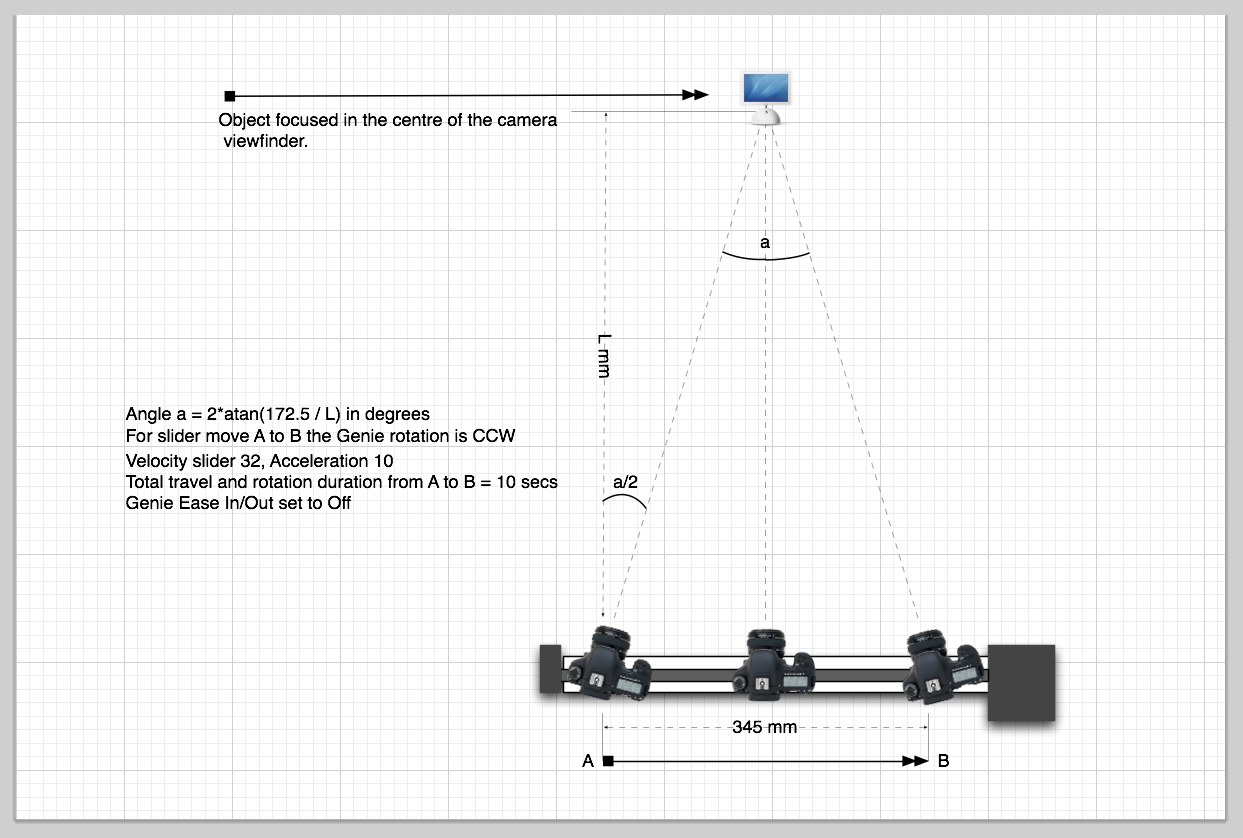

fig 1 : top view of the set up

The figure above shows my setup, whereby the object, which the camera VF is focused upon, is found at a distance L from the middle position of the camera slider travel. At position A the camera is turned at an angle a/2 with respect to the vertical direction in order to place the focused object in the middle of the VF. As the camera mechanism progressively moves from A to B, Genie (with the camera on top) rotates counterclockwise (CCW) for a total angular travel of angle a, in order to continuously maintain the focused object in the centre of the VF. Also, the total travel time of the camera system from A to B should be the same with the total angular travel (rotation) from the camera's initial angular position, moving CCW to its end position. Of course, if one plans a move from B to A, then Genie needs to rotate itself in the clockwise (CW) direction by the same angle 'a' always.

So the process to achieve this in the setup above is as follows:

1. I first made the decision to use 10 secs as the total sliding travel time (and Genie rotation). Genie accepts this duration as a parameter, but in Edelkrone I had to apply trial and error to define the right speed for the travel distance. For 345 mm distance from A to B, I had to select 32 as the camera velocity and 10 as the maximum acceleration (meaning, no easing-in and -out at the start and end of the linear travel). Indeed, with these parameters the camera on the SliderPlus travels the 345 mm distance in acceptably ten seconds.

2. The camera, mount on the FlexTilt Head remains fixed in terms of angular displacement with respect to the Genie body. It is Genie that automatically rotates about its vertical axis. Other (height or tilt) adjustments are done via the FlexTilt Head. While adjusting the setup and focus on the target, it is perhaps easier to check results on the camera monitor at the back of the body instead of thru the VF.

3. Next, one needs to set the rotating angle parameter in the Genie settings. Measuring the distance L and applying the simple formula shown in the figure provides a first good approximation of the rotation angle that needs to be set as a Genie parameter. Also, don't forget to set (Genie's Advanced Settings) the Easing-in and -out to OFF. To make sure the angle works, you trigger Genie to rotate to its end position and in parallel you may move manually or automatically the slider to position B. You then check the camera to verify that the object has still remained in its initial VF relative position. If not, depending where it ends up to, you may have to increase the angular Genie parameter or decrease it. If the object is left of the original focus position it means that the angular parameter is set low and needs to increase a little. If the object ends to the right, the angle was too large and needs to decrease. Act accordingly and check again until you achieve perfect alignment.

4. After the angle is entered in the parameter, and the Action Module was programmed in the Wizard mode to travel from A to B in ten seconds, the system may be set in motion. First you prepare the video shot parameters on the camera and hit the Record button next. Right after that, press the Start/OK buttons simultaneously on both, the SliderPlus and the Genie. Both devices start automatic motion, with the SliderPlus sliding from A to B and the Genie rotating the camera in CCW direction. In ten secs the travel is over, and one may set the Recording function back to standby.

This is certainly much more of a burden compared to Edelkrone's Target module. On the other hand, if you happen to own other sliders, as I do, you are actually adding value to those, even more so if motorised sliding was not previously an option. Unfortunately, Edelkrone's Action Module only fits (for obvious reasons) Edelkrone sliders. 

On the other hand, once you calculated the angles for a few practical values of L, you can memorise what goes with what, and don't have to go thru the calculation and trial and error burden each time. For instance, I know that for a distance of 85cm the angle is about 20 degrees. If I made sure my target object is at 85 cm, I could always use the Genie preset that I have already stored for these particular parameters, and Bob's your uncle. If I don't like the VF scenes at the distances I preset, I can always use different lenses or zooms to adjust.

A common problem on similar devices, like Genie and Slider+, is the associated noise their motors produce. But as most people shoot B-rolls based on similar setups and use external audio equipment for better sound control, the noise will get suppressed in post and in so doing, it is less of a problem.

Thursday, July 30, 2015

Windows Version 10, or how to experience the five stages of grief in just a few hours

When I heard Microsoft was giving away Windows 10 for free, I said to myself, why not, check it out to find out what they learned all these years, if anything. The phenomenal growth their sworn enemy in Cupertino has achieved in terms of global cash and revenue growth, but also in outpacing the global PC market by selling gazillions of Macbooks, must have taught them something about what users think an OS should be doing, right? Wrong... Continue reading.

Couple years ago I bought me a fancy SONY Vaio laptop with all its bells and whistles. I wasn't planning to be using it for my daily tasks, though. I only needed it to run Microsoft Money 2007, since I was used to that app, and it addressed all my "personal finance" requirements. I did use the Vaio for a couple of months like this, and it proved quite a burden, I am afraid to admit, mainly in terms or response times and continuous Windows updates for newly discovered security holes. I was no more used in handling Windows tasks (I was spoiled in the meantime by the Mac OSX, you see), so I abandoned the Vaio in some corner in the loft. I went to install Parallels on my iMac instead, and thus moved Money into a Windows sandbox running under parallels. Case closed. Proven fact, Windows running under Parallels on a Mac is way faster and more responsive than on any big dog Wintel configuration you can think of.

One thing is certain. The Vaio was still there, shut down and patiently collecting dust, almost untouched for 2 years. No special drivers, not even printers, no fancy configurations or customisations, almost all of it in its original factory settings. It was supposed to be 64 bit Windows 8 Home edition. Didn't need more than that anyway. So, when I heard the news on the radio yesterday morning (amazing how the Media are hooked to play MSFT's marketing game all along), I said to myself, let's see what the buggers did this time. Old wine in new bottles all over again, or did they clone Apple or Google instead?

So, after dusting the Vaio, I humbly started the route to my software Golgotha (much I knew then of what was to come), hopeful to be able to upgrade to 10 in, say, a couple of hours. From my Mac experience of moving into a new OSX version, I never had to wait longer than half hour from start to finish, so I reckoned, since MSFT is far less efficient, probably it'll take me four times that, couple of hours max. Much I knew then and hopeful I was. One day in the life of Ivan Denisovich was like staying in a $2K a night luxury suite at the Four Seasons in Paris, compared to what I had to go through. Like I suggested in the post's title above, I went from denial, to anger, to depression and finally acceptance in less than 10 hours. After that I kept taking anything MSFT had to throw into my face with a bitter smile.

I started the process at 11 am on Wednesday the 29th of July, official day of the V10 launch. My "factory settings" Vaio in its V8 64 bit installed version took until 4 am the next morning (!!!!!!) to complete updating 2.5 year long fixes (last applied dated back to Jan 2013) and its subsequent upgrade to 8.1. When I opened the laptop at 8 am this morning it still claimed there were even new arrivals of updates from 4 am to that moment and I was subsequently obliged to do them. I categorically refused this time. I rebelled! "F you", I shouted! It was obviously a bitter joke. I never installed anything special on that laptop, ever, and it took 18 hours to do the updates and upgrade to 8.1 !!! 18 hours of my precious and shortening life! On my deathbed I'll think of this experience again, I promise you. I just let it do its own thing by using defaults all the way. Like I said, no personal customisations were ever performed and it was in plain English that the OS was installed.

Eventually, by this morning the Vaio was able to run V8.1 after all. Not that it was any intuitive at all to go confirm the version of Windows I was running. What in Apple OSX takes two bare clicks to find out (the OS version you are running), in Windows proved a desperate search of computer settings, some place somewhere out there but not knowing where exactly!

I next rushed on my monitor to spot the little windows symbol on the right side of the balk, but to no avail. I read that you had to do this in order to get invited to upgrade to 10; another weird idea of Microsoft's to contain /span>downloads queueing in the billions by their users out there. Unfortunately, no icon was to be seen anywhere among the megapixels of my laptop monitor, anywhere at all. I dug into the net next, and spotted some horror stories about how to fix that problem, some suggesting it was extremely complex to achieve that without any guarantees of success, up to someone proposing to recreate the reservation app itself via code he offered to copy paste into a Notepad document, rename it into some form of command file and run it. No way I'd do that. The times I had to do witch magic to get MSFT operating systems incl. MS-DOS in the eighties and early nineties to do the things they were supposed to do has loooong gone and will never come back, I bet you. In my age, every minute of precious life counts. I'm not gonna waste it, not a single second, in MSFT OS workarounds because they decided to become one garbage can of technicians knowing about OS development as much as I know about Mandarin Chinese! No way!

Thankfully, and about the moment I was ready to throw the entire Vaio into the bin, with its brick and all, I found this Godsent CNET article claiming there was a way to download the V10 ISO files directly from Microsoft's site, without having to wait for their Highnesses in Seattle to respond to my humble reservation request via an impossible to find app icon, and then download the V10 installation files into my laptop, when it pleases them. I said to myself, why not? Let's see if it works this way. CNET is way more rational than MSFT, anyways...

Forgot to mention though, that in the meantime, I had spent ages on the MSFT web pages to figure out how to do the upgrade, and I have to say, the feeling was that I was being pushed into the secret pathways of their makeshift labyrinths to make it extra hard, read impossible, for any casual user to ever get this infamous upgrade. I happen to be a seasoned computer user, mind you, starting with Fortran 2 back in 1973! Imagine what a poor soul with only a few years messing around with Windows would do in such a mess. One particular page of theirs kept sending me via a hotlink back to itself. Over and over. Can you figure that? Really? Looping the loop! There is no way to even think comparing them with Apple on this very issue. Apple is miles ahead... what am I saying, lightyears ahead. Things that are of no concern to a user are kept totally out of the users' sight in Cupertino,Ca. In Seattle, every bit they are doing over and over again, from closing down and rebooting to copying files, they'll inform powerless and desperate users in seriously upsetting ways, like "we are taking care of a few things", or "checking to see if you got enough space for upgrades", or shit like that, and keep busy doing that for minutes to hours! How long to you need to check on a 21st century laptop and find out if there's a few miserable gigabytes available to put a new operating system in place? Ten minutes? Half hour, you said???? You gotta be kidding me. Things like that turn you (during your "anger" stage of grieve) into a ranting Lewis Black himself, and this in a matter of secs.

I'm simply curious... what is so technically sophisticated for a simple security loophole fix to take so long to be installed?! And will they ever achieve a moment that their stuff has no more deep security holes like we've seen in the last 25 years? Why do they even pay those gazillion developers, spending billions of dollars, to maintain such a monumental OS mess called Windows ? Why don't they ever do a serious rewrite, like Apple did in OSX fifteen years ago? How come is their system so vulnerable and needs to by fixed every week? And will they ever learn that their OS in the year 2015 should no more use those ugly and old-fashioned configuration windows that their 3.11 version used back in the last decade of the past century? Indeed, will they ever learn? Why should they do that after all? Bill Gates gets richer by the day even to this day, playing a role of the planet's greatest philanthropist and counting his 87 Billion of paper money from holding onto his MSFT stock. In his shoes, anyone can still believe that Windows was and is exactly what billions of users worldwide eventually need and want!

Long story short, and there's still so much I could narrate from my last 24 hours of living the Windows upgrade nightmare, but as I said, I reached the last stage of grieve, which is acceptance of my fate. In any case, I have no issues with the Windows user experiences since, once all installs are done, I'll shut down the darn Vaio and go back to my beloved Mac OSX boxes and laptops, and to the legacy his Sainthood, Steve Jobs, may he RIP, has left us with.

But it would be a spoil to deprive you from my ultimate experiences from the v10 installation itself. Because I eventually managed to get it installed. That's right! Sure did! In its own, it's gotta be the black humor joke of the 21st century. After downloading the infamous ISO image, following CNET's article, with the v10 install files, I started the procedure at 8:20 am this morning and at 10:10 am, almost an hour and 50 minutes later, I can claim I became the proud owner of an upgraded Vaio into Windows 10, 64bit. On a first sight it does look nothing more, nothing less than a somewhat improved look and feel version compared to the disaster 8 or 8.1, for that matter. At least now they stopped displaying those stupid blocks at start-up, full of useless functions, while obscuring simple things like computer settings and File Explorer. As before, the install took multiple reboots and many of the likes of "still a few more things to arrange and install" and more like this. And the best of all, the cherry on the cream indeed, I found myself hardly exploring the new version, and a bunch of new updates were waiting to get implemented. Incroyable mais vrai!

I'll leave you with a few screenshots that I was served with, before the V10 was eventually confirmed. I strongly believe, this must be Satya's idea of humor for sure, and that life should be taken lightly, as it's too short.

Update: After spending about 5 hours on V10 now, 24 hours later, I must admit that this must be their best version ever. Not just a marketing trick. They seem to have in fact rewritten almost everything I tested, had copied Google's and Apple's minimal design in many aspects, transparencies and animations all over, and the OS seemed, how can I say this... seemed humbled. The traditional Microsoft arrogance we are used of seemed to have gone away. For the first time ever I saw their apps centred around the user and his/her concerns. That's a novelty indeed. V10 is also consistent among apps and menus and such. Indeed a redesign. I'd guess, this would please Windows casual users for sure. Good for them. Not that I's consider going back to V10 from Mac OSX any time soon. Apple is still light years ahead in so many aspects, however, I feel good about the billions MSFT users out there who, after 25 years of painful experience, eventually got something along the lines of Google and Apple. Maybe I should hold to my MSFT stock a few more days... see how the market reacts. In any case, Satya Nadella appears a lot more realistic than that jumping monkey boy of Steve Ballmer. I couldn't have imagined a V10 under Ballmer for sure. Never ever. He was too thick and far too arrogant for that.


Monday, March 9, 2015

Arts and concepts

I recently watched a Youtube post on conceptual photography that made me think about artistic expression once more. I always struggled with the question whether a visual artist should consciously have something to communicate thru his/her artistic work, whatever that work might be. In the written word, literary or not, it is rather imperative that authors should always have a message to pass to their intended audiences, either clearly stated or in a hidden, rather ulterior way. It is universally assumed that texts are used to communicate ideas, points of view, impressions, facts, and emotions about anything authors might choose to focus upon. Is it thus the same with visual artistic expression? Do visual artists have to communicate a message preferably based on a concept as well?

One should reasonably expect that motion pictures, whose objective is visual story-telling, lust like in literature, do plan to communicate 'something' known to the Director and his/her crew even before production starts. Whether they are successful in achieving this effectively only their audience and/or film critics will eventually tell. In fiction movies, as well as in documentaries, there is always a story to be told, a message to be passed to the audience. Thru cinematography, actor performances, stage design, editing and the soundtrack they are also adding the necessary emotional impact to their statement to engrave the story into the memory of spectators for ever, as emotional memory is always the strongest and the most persistent.

How about photography? This is where 'conceptual' photography enters the stage. There are 'committed' photographers who make their life's work to shoot certain subjects and those alone, in certain conspicuous styles they preferably invent for themselves, all in the service of telling their story in their own special way. There's a thought process behind each photograph of theirs and this could be around emotional impact in its weakest expression or emotion enhanced with actual information in its strongest form. Shooting for instance photographs of old people, counting their remaining days in a 'home', and using black and white sharpness to draw even stronger the sensation of human body decay, tells you something about the photographers continuous intent to illustrate a mostly hated part of human life: ageing. There are thousands of subjects that have been used by conceptual photographers in their quest for passing a message and a concept. One known Japanese artist I have read about (Hiroshi Sugimoto) made a tour of the US and visited theaters, especially older classic ones, and photographed them systematically, using insanely long exposures (for the duration of the film projection) on a 4x5 Technical camera. By doing this he managed to eliminate any moving objects from his frame (mainly men and women spectators). His concept was to reveal the element of time in photography. The result, due to the size of his negatives and the advantages of using technical cameras to manage frame geometry and lens aberrations better than any other photographic technology, was a series of stunning photographs of the interior of hundreds, maybe thousands of theaters that he eventually printed in a book for the aficionados of the genre.

On the other side of the 'scale' we find photographers like Bresson, Frank and Leiter who photographed what appeared in front of their lens that happened to move them aesthetically and emotionally. They simply wanted to share that personal experience with their audience. Is there anything wrong with that? In interviews Saul Leiter has given about his art, he categorically ignored and rejected critics who tried to discover a concept behind his photography. You simply shoot a frame because you just feel the need for doing it, not because you planned it like that. If it then happens to create specific emotional experiences to any future viewer of that picture, so be it, so much the better... As for Bresson, and his impeccable framing of subjects, I don't quite believe that he was staging beforehand each and every frame he shot. That would be silly to assume for example that he has been waiting for hours the young boy stepping forward with an oversized in comparison bottle of wine, and catch that moment of his hilarious childish look, shining with pride about his feat under way. It sounds too improbable to believe that Breton set that up. He simply took advantage of a remarkable in those days portable camera, the Leica, and his photographic eye and personal interests made him capture the decisive moment the way he felt fit. He shot as a photojournalist, spontaneously. Anything wrong with that? Certainly, many Bresson experts, long after the facts, built a myriad stories behind each and every photograph of his to prove their point of view, that only photographs with a 'concept' can eventually claim genuine artistic value. 

I personally believe there is merit to both photographic approaches. Often, conceptual photography is not aesthetically interesting per se. As an example, I remember a temporary expo at the MOMA, NYC, not long ago of a woman artist, who filled an entire room (or was it several?) with frames of alike dimensions containing small uninteresting pictures and supporting documentation of individuals from India, who all shared a common detail in their lives. While still alive, they were declared to the authorities by their relatives as deceased in order for the latter to pocket the victims' inheritances. The 'concept' was an interesting one indeed, but what has this got to do with art whatsoever? Apparently, in the mind of many art aficionados, a lot!

I quite admire those photographers and other artists (including architects), who create works as a result of a concept they carefully developed beforehand. There is a lot of brainpower necessary to build artistic concepts. In many occasions, the artists concerned will simply and exclusively do that alone. Develop the 'concept'. Jeff Koons and Jan Fabre are examples of artists who often do that. Koons' Michael Jackson and his pet monkey sculpture, sold for millions of dollars, and Jan Fabre's Pietas that appeared in the Venice Biennale a few years ago were entirely built by professional craftsmen who simply followed the artists' instructions. Intriguing! At least Michelangelo and Caravaggio built their own works for the most part... Not Rubens though...

However, there's still a lot of value in the works of photographers, whose frames express their accidental state of mind at a given moment. Like I said, such photographers' intent is to freeze time and capture the moment for reasons of own personal excitement the very instant they decide to click their camera shutter pointing to a given scene that they are looking at thru their viewfinder. During post-processing they might possibly enhance that impression even further just to make their personal vision more explicit. Nevertheless, the original frame was indeed shot spontaneously, and not following a grand scheme of premeditated thought stream.  


Wednesday, November 12, 2014

Alkinoos Ioannidis - A small suitcase (Μικρή Βαλίτσα)

I always liked this kid, and I am glad I was proven right after I saw him performing this last weekend, on a live show at the Yallino Music Theatre in Athens, Greece. Despite a bad cold he'd been struggling with, poor thing, he managed to perform a superb show that lasted longer that anyone could have ever expected. I personally consider this singer-songwriter one of the best ever born under the sun, certainly among the known and celebrity Greeks, alive or dead. His talent is limitless in terms of song composition, lyrics, his virtuosity in playing various musical instruments and the quality of his own vocal chords (technically and in terms of sound color and passion). Above all, his quality in terms of musical track record can only compare to Manos Hadjidakis. I am sure, if Manos lived today, he would certainly envy Alkinoos for his musical writing-singing skills, but he would have also wanted him to sing his songs instead of producing his own. I have owned for years most of Alkinoos albums, and went on to buy his latest only this last Sunday (cover shown here) without the shadow of a doubt! His skill in combining local folk sounds by traditional Greek instruments (bouzouki, Cretan lyra, laouto) with the classic sounds of orchestral string instruments (violin, viola, cello and contrabass) is beyond your wildest dreams. Actually this combination takes place in two dimensions. First, in terms of harmony among the two types of instruments offering to the listener the finest taste of Greek sound dressed in the best quality possible acoustic colour, and second, in terms of combining traditional dance melodies with classic jazz scherzos and state-of-the-art electronic patterns. I witnessed the cello and violin being played in staccato like it were a guitar or a bouzouki in ways I have rarely seen before, with his band musicians's virtuoso fingers (cello, violin and contrabass) only tapping the strings on their instruments's fingerboards. The pleasure was simply unheard of. I have rarely felt so much energy as Ioannidis had found ways to lead his entire orchestra into a powerful trance that drove the audience into extreme and spontaneous applause. Entirely different than the trances people enjoy in vulgar mega dancings with vulgar DJs with electronics and massive speakers that on their own could fill an entire theater like the one I attended to. The singer-songwriter also writes his own versions of Rap music, probably in order to address younger audiences, and for sure comparing theirs to these songs the big Rappers of the world would simply flush. A great musical personality he is indeed. Unfortunately, dickheads in Greece prefer many other ridiculous performers instead. Appears as if contemporary Greece is no more appreciative of quality music. Should we blame the current financial crisis for this too?

Talking about Greece, the only negatives in Alkinoos performance were the following few (and had nothing to do with the artist; his only personal issue were related to his germs, but as I already suggested, no-one witnessed any negatives on his performance because of that):

a. Theater/venue management: HUMONGOUS FAIL!!! Allowed far too many people into a dangerously packed area with so many standing up during the whole 4 hours performance. In an unfortunate case of say, a fire accident, at least several hundred panicking people would have been stampeded, to say the least. I felt quite uncomfortable with being in the middle of that assembly.
b. Allowing smokers to smoke. Especially female smokers chain-changing cigarettes during the entire show. To the theater management's credit, there was airco provided , but in Greece, with audiences chain-smoking like Turks (Greek expression) no reasonable airco could do the job.
c. Behaviour of the audience. Bad mannered, awfully raised, smoking jungle chimps, without respect to anyone among the rest of us, who came to enjoy the artist and his orchestra, shouting most of the time, giggling, laughing loud, talking loud to their companions like they were in a bar, showing off, turning their backs to the orchestra and trying to spot a partner of the opposite or same sex to get laid as part of their Saturday night out. Mostly women it were those misfits, with blond badly dyed hair (someone must have told them that Greek men like sexing in blond), heels adding 20 cm to their ugly legs, horny faces drooling with cheap make-up. Some looking like 5-euro whores, out-of-tune scream-singing the lyrics a second earlier before the artist sang them himself, just to show off they knew the score! Such a chaos is only possible in Greek theaters. To think that 'theater' itself was invented here 3 thousand years ago makes your heart bleed. Sheer animals in a jungle. I felt sorry for the artist and all other artists in general performing in Greece, having to cope with this type of rude monkeys to earn a living. A shame really. Showing disrespect to both artists and to those few like myself, non-smokers, who came here to enjoy the sounds of a rare musical talent, staying speechless, and almost mouthless, breathing from the nose alone, hoping for the possibility in so doing to filter out the nicotine from the tobacco polluted ambient air.

UPDATE: I found this on Youtube from the show I attended and wanted to share it with you. As far as "I rest my case" on my arguments about the disrespectful Greek audience, it is obvious from this clip. Judge for yourselves.